
If you or your child suffers from asthma or rhinitis, you know the struggle: traditional vacuums clean the house of visible dust, but the act of vacuuming triggers a sneezing fit anyway. It feels counterintuitive, doesn’t it?
Here is the uncomfortable truth: most traditional vacuums in the Philippines are actually contributing to indoor air pollution rather than solving it.
The Problem with Traditional Vacuums: Bags and Filters
Traditional vacuums rely on suction to pull dirt into a bag or a dry canister. For the air to get out, it has to pass through holes in the bag or filter. As the bag fills up, those holes clog, and suction weakens well before most people notice or replace the bag. To keep airflow moving, the vacuum often forces microscopic particles—dust mites, pet dander, and pollen—right back out into the air you breathe.
That “vacuum smell” you notice when cleaning? That is actually the smell of burnt dust and bacteria being blown back into your room — a problem unique to traditional vacuums, since nothing is trapped for good.
The Rainbow Solution: Wet Dust Can’t Fly®
The Rainbow Cleaning System operates on a different principle entirely: Aerodynamics and Hydrodynamics.
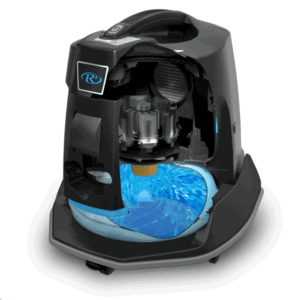
It uses Mother Nature’s most powerful element—water—to trap dirt and odors. When you use the Rainbow SRX, dirt is pulled into a swirling water bath. Once dust gets wet, it cannot fly back into the air, no matter how long the cleaning session runs or how full the basin gets.
Why It Matters for Your Health
- Certified Asthma & Allergy Friendly™: The Rainbow provides certified air cleaning. It doesn’t just clean your floors; it washes the air.
- HEPA Neutralizer Filtration: Any microscopic particles that somehow survive the water bath are captured by the HEPA Neutralizer Filtration System, a second layer of defense most single-stage dry filters simply don’t have. This removes nearly 100% of dirt and contaminants.
- No More Sneezing: Because the dust is trapped in water, you simply pour the dirty water away at the sink. No dusty clouds when emptying a canister, and no bag to wrestle out of a vacuum body!
Should You Replace Your Current Vacuum?
Not every household needs to switch immediately. If no one at home has asthma, allergies, or sensitivity to dust, a well-maintained vacuum with a good filter may be manageable for now. But for households with young children, elderly family members, or anyone with a respiratory condition, the math changes quickly — the health cost of recirculated allergens tends to outweigh the convenience of sticking with what’s familiar.
A simple test: vacuum a room, leave it closed for an hour, then walk back in. If the air feels noticeably dusty or triggers any reaction, that’s a strong signal the equipment is part of the problem, not just the mess on the floor. Keep a short log for a week — noting symptoms after cleaning days versus non-cleaning days — and the pattern usually becomes obvious fast.
What to Check Before You Upgrade
- Filter type and rating: A true HEPA filter performs far better than a generic “HEPA-style” label, but still requires air to pass through a dry membrane.
- Seal quality: Even a great filter is undermined by a poorly sealed canister that leaks air — and dust — around its edges.
- Emptying method: Dumping a dry canister or bag is one of the dustiest moments in the whole cleaning process, often undoing much of the benefit of vacuuming in the first place.
- Certification: Look for independent certifications like Asthma & Allergy Friendly™ rather than taking a manufacturer’s own claims at face value.
Ready to Breathe Easier?
Stop recycling dust and start eliminating it. Experience the difference of a water-based clean in your own home — most families notice less sneezing and a cleaner-smelling room within the very first session.
Traditional Vacuums vs. Water Filtration: A Side-by-Side Look
Traditional vacuums and water-filtration systems solve the same problem — dirty floors — in opposite ways. Bagged and bagless traditional vacuums trap dirt in a dry filter that must let air pass through it, which means some of what’s captured eventually leaks back out as the filter loads up.
A water-filtration system skips the dry filter step entirely. Dirt is pulled into a water bath where it stays wet, and wet dust simply can’t become airborne again — which is the core limitation traditional vacuums can never fully engineer around, no matter how good their filter rating is. It’s a difference in physics, not just marketing, which is why the gap shows up so clearly in households with allergy sufferers.
Signs Your Traditional Vacuum Is Working Against You
- A dusty smell right after vacuuming — a strong sign fine particles are being exhausted back into the room.
- Sneezing during or right after cleaning — the clearest symptom that traditional vacuums are recirculating allergens instead of removing them.
- Visible dust settling again within hours — a sign the vacuum redistributed fine particles rather than capturing them.
Traditional Vacuums and Allergies FAQs
Can traditional vacuums really make allergies worse?
Yes — if their filter is clogged or low-quality, they can exhaust fine dust, pet dander, and pollen back into the room faster than normal foot traffic would stir it up.
Are all traditional vacuums equally bad for allergies?
No, HEPA-filtered models perform better than basic ones, but even a well-sealed dry filter still requires air to pass through it, which a water bath does not.
How is the Rainbow different from HEPA-filtered traditional vacuums?
The Rainbow traps dirt in water first, then runs any remaining fine particles through a HEPA Neutralizer Filtration stage — two layers of capture instead of the single dry filter traditional vacuums rely on. Learn more about how it also handles dust mites specifically.
Book a Free In-Home Demo Today!
See the Rainbow SRX in action. Contact us to schedule a no-obligation demonstration and discover how clean your home should be.